







Institutional participation in digital asset markets increasingly depends on understanding that tokens do not represent a single uniform asset class. The rapid expansion of blockchain markets has created a landscape where economic rights, governance functions, and collateral structures vary significantly between token designs. For investors allocating capital to digital networks, this distinction directly affects risk exposure, liquidity expectations, regulatory treatment, and operational oversight.
As global digital asset market capitalization fluctuated between roughly $1.6 trillion and $3 trillion across 2024 and early 2025 according to industry data tracked by market infrastructure providers, institutional participants increasingly recognized that treating all tokens as interchangeable speculative instruments creates structural portfolio risk. Within that broader market, stablecoins alone exceeded $160 billion in circulating supply by late 2025, while tokenized real-world assets surpassed $30 billion in on-chain value according to RWA infrastructure monitoring platforms.
These shifts highlight a central issue for investors navigating digital markets: token design defines economic purpose. Understanding token types explained within broader digital asset categories has become a prerequisite for responsible allocation decisions.
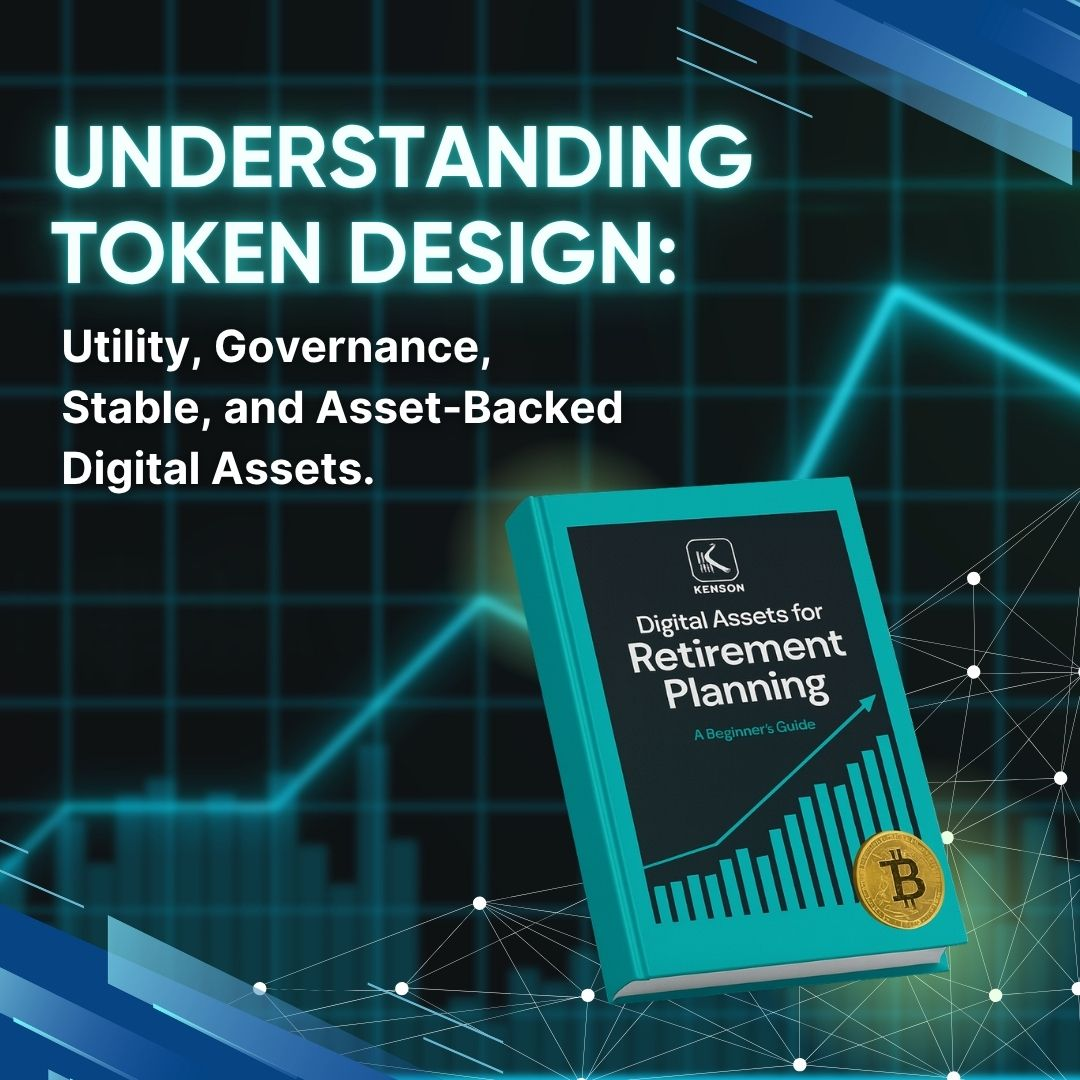
The book Digital Assets for Retirement Planning addresses this distinction directly, emphasizing that long-term portfolio construction requires differentiating between network utility, governance participation, and asset representation rather than evaluating tokens purely through price volatility.
Structural Differences Between Token Economies
Utility tokens represent one of the earliest and most widely recognized digital asset structures. These tokens provide access to network services, computational resources, or application functionality. However, their economic value depends heavily on network usage rather than ownership rights.
Ethereum remains a prominent example. The network processed over $4 trillion in on-chain stablecoin settlement volume during 2024 alone according to blockchain analytics research, illustrating how network usage drives demand for transaction-related tokens. Yet this form of value differs fundamentally from equity-like claims or collateral-backed instruments.
Governance tokens introduce a separate economic layer. These tokens grant voting authority over protocol parameters, treasury allocation, or network upgrades. Decentralized finance protocols frequently rely on governance tokens to coordinate community decision-making across distributed participants.
Institutional allocators increasingly analyze these governance structures as part of investment analysis and portfolio management frameworks. Voting power distribution, treasury management practices, and governance participation rates influence how resilient these systems remain during market stress.
Distinguishing between governance influence and economic ownership becomes particularly important when evaluating altcoins vs. major cryptocurrencies, since governance rights do not necessarily translate into financial claims.
Stable Representations and Asset-Backed Tokens
Stablecoins represent another major category within digital asset markets. Unlike utility or governance tokens, stablecoins aim to maintain price stability through collateral reserves or algorithmic stabilization mechanisms.
The Bank for International Settlements noted in 2024 research that stablecoins now represent one of the most actively used forms of digital settlement infrastructure in crypto markets. Daily stablecoin transaction volume frequently exceeds $70 billion across global networks, highlighting their operational importance for liquidity and settlement.
However, stable representations introduce new forms of counterparty and reserve transparency risk. Regulatory authorities including the European Central Bank and the Hong Kong Monetary Authority have increasingly scrutinized reserve disclosure standards and redemption mechanisms as stablecoin adoption expands.
Parallel developments are occurring in tokenized real-world assets. BlackRock’s tokenized money market fund launched on Ethereum in 2024, representing one of the most visible examples of asset-backed tokenization entering institutional finance. The initiative demonstrated how traditional financial instruments can be represented through blockchain settlement layers while maintaining underlying collateral structures.

These developments illustrate how blockchain-based investment opportunities increasingly intersect with traditional capital markets infrastructure.
Institutional Behavior and Portfolio Construction
Institutional investors increasingly recognize that digital assets cannot be analyzed through a single valuation framework. Utility tokens, governance tokens, stable representations, and asset-backed tokens each introduce distinct economic characteristics.
Fidelity Digital Assets reported in its institutional survey that roughly 74 percent of institutional investors expressed interest in digital assets as of 2024, with diversification and technological exposure cited as primary motivations. Yet the same survey emphasized that institutions differentiate between digital asset categories when evaluating long-term portfolio integration.
For asset managers responsible for digital asset portfolio management, token classification influences liquidity modeling, custody architecture, and governance participation requirements. Stablecoins, for instance, function primarily as settlement instruments rather than speculative exposures, while governance tokens may require active voting participation to preserve economic influence.
These distinctions increasingly shape operational decisions among digital asset management consulting services and other institutional infrastructure providers tasked with designing risk frameworks for tokenized markets.
Regulatory Developments Reshaping Token Classification
Regulatory frameworks are gradually formalizing token classification standards. Europe’s Markets in Crypto-Assets (MiCA) framework introduced detailed distinctions between asset-referenced tokens, e-money tokens, and other crypto assets. The legislation represents one of the first large-scale regulatory attempts to formally categorize token structures.
Similarly, global central banks continue exploring tokenized financial infrastructure. The Hong Kong Monetary Authority’s Project Ensemble and the European Central Bank’s digital euro experiments reflect ongoing institutional experimentation with tokenized financial settlement.
These initiatives illustrate why digital asset consulting for compliance has become an increasingly important consideration for financial institutions entering digital markets. Token classification affects disclosure obligations, custody rules, and investor protection frameworks.
Institutional allocators evaluating digital asset investments must therefore consider not only technological design but also regulatory alignment.
Operational Realities for Asset Managers
Managing exposure to multiple token categories introduces operational complexity for institutional investors. Custody arrangements, governance participation mechanisms, and liquidity access vary significantly across networks.
Institutional custodians such as Coinbase Custody and Fidelity Digital Assets now support hundreds of digital assets, yet not all token structures are equally compatible with institutional risk controls. Governance tokens, for example, require mechanisms allowing custodians or asset managers to participate in voting processes without compromising custody integrity.
Similarly, DeFi-based assets introduce operational challenges related to smart contract risk and liquidity fragmentation. These factors explain why institutional participants often rely on best practices in digital asset consulting when developing internal governance frameworks for digital markets.
As tokenized financial infrastructure expands, asset managers must balance innovation with operational resilience. Ensuring security in digital asset management increasingly requires evaluating the economic function of each token within a broader portfolio context.
What This Means in Kenson’s Framework
Within the research framework outlined in Digital Assets for Retirement Planning, token classification serves as a foundational element of long-term portfolio discipline. The central premise is straightforward: digital assets represent a diverse collection of economic structures rather than a single homogeneous investment category.
Understanding digital asset categories enables investors to evaluate economic incentives, governance responsibilities, and collateral structures associated with different token designs. For institutions working with a digital asset strategy consulting firm, this analysis often informs risk frameworks governing custody arrangements, liquidity management, and governance participation.
From this perspective, responsible participation in digital markets depends less on short-term price expectations and more on structural clarity. Investors evaluating long-term investment in digital assets increasingly prioritize transparency around token design, governance authority, and underlying economic function.
Recognizing these distinctions allows institutional participants to navigate emerging markets with greater discipline while maintaining awareness of the operational and regulatory dynamics shaping digital finance.
Understanding Digital Asset Structures
Digital markets continue evolving toward a multi-layered financial ecosystem where utility tokens, governance systems, stable representations, and tokenized assets each serve distinct economic roles. Educational resources remain essential for investors seeking to understand these structures and their implications for capital allocation and systemic stability.
Those interested in exploring how institutional research frameworks analyze token design and digital asset market structure can continue the conversation with the Kenson research team.
Disclaimer: The information provided on this page is for educational and informational purposes only and should not be construed as financial advice. Crypto currency assets involve inherent risks, and past performance is not indicative of future results. Always conduct thorough research and consult with a qualified financial advisor before making investment decisions.
“The crypto currency and digital asset space is an emerging asset class that has not yet been regulated by the SEC and US Federal Government. None of the information provided by Kenson LLC should be considered as financial investment advice. Please consult your Registered Financial Advisor for guidance. Kenson LLC does not offer any products regulated by the SEC including, equities, registered securities, ETFs, stocks, bonds, or equivalents”