







Meta:
The defining operational feature of digital asset markets is not simply token issuance or network usage. It is the mechanism by which transactions are verified without a central authority. For institutional investors and allocators evaluating digital asset investments, verification architecture determines how trust is distributed across the network and how resilient the system remains during periods of stress.
Verification mechanisms influence settlement reliability, censorship resistance, and the economic incentives that secure a network. These factors ultimately shape capital durability. As global institutions continue investing in cryptocurrencies, understanding how decentralized transaction verification functions in practice becomes essential for evaluating risk exposure.
The digital asset market has grown into a multi-trillion-dollar ecosystem. According to data aggregated by CoinMarketCap and industry research firms, total digital asset market capitalization surpassed $2.6 trillion in early 2024 before stabilizing amid broader macroeconomic tightening. Meanwhile, blockchain networks now process billions of dollars in value daily, illustrating that decentralized transaction verification has evolved from an experimental mechanism into a critical financial infrastructure layer. For institutions conducting investment analysis and portfolio management, the design of verification systems increasingly informs strategic allocation decisions.
Structural Risk and the Mechanics of Consensus
Verification in decentralized networks replaces centralized approval with distributed consensus. Instead of relying on a clearinghouse or financial intermediary, transaction validation occurs through coordinated participation among independent network actors. These participants maintain network security by confirming transaction legitimacy and updating the shared ledger state.
Consensus architecture determines the balance between speed, security, and decentralization. Proof-of-Work systems such as Bitcoin rely on computational competition to validate transactions. The Bitcoin network’s hash rate surpassed 600 exahashes per second in 2024, according to data from the Cambridge Centre for Alternative Finance, reflecting unprecedented security expenditure across the mining ecosystem. High hash power increases the cost of malicious activity but also introduces energy consumption considerations and slower transaction throughput.
Alternative consensus models such as Proof-of-Stake address these trade-offs by replacing computational competition with economic stake commitments. Ethereum’s transition to Proof-of-Stake in 2022 reduced network energy consumption by approximately 99.9 percent, according to the Ethereum Foundation. However, staking models introduce different governance considerations, including validator concentration and liquidity dependencies.
For institutional investors evaluating blockchain-based investment opportunities, consensus design therefore becomes a structural risk factor. Network security depends not only on technological design but also on the economic incentives motivating network participants.
Institutional Behavior and Verification Assurance
Large allocators rarely engage directly with raw network mechanics. Instead, they evaluate verification reliability through infrastructure providers and custodial frameworks. Institutional participation in digital assets has expanded rapidly as verification reliability has improved and market infrastructure has matured.
A 2024 survey conducted by Fidelity Digital Assets found that more than 70 percent of institutional investors expressed interest in digital assets, with many allocating capital through regulated custodians and investment vehicles. These institutions typically access digital asset markets through a digital asset management company, exchange-traded vehicles, or funds operating under structured governance frameworks.
This institutionalization of digital asset markets has increased demand for operational transparency in verification systems. Asset managers operating in crypto asset management environments must evaluate validator reliability, transaction finality, and settlement risk. Verification speed, network uptime, and validator decentralization all influence operational stability.
The result is a growing professional ecosystem supporting institutional market participation. Firms specializing in blockchain and digital asset consulting increasingly help institutions assess how verification frameworks align with operational risk policies.
Regulatory and Infrastructure Developments
Regulators have also begun examining decentralized verification systems more closely. Financial authorities increasingly recognize that distributed consensus introduces new governance considerations for financial infrastructure.
The Bank for International Settlements has highlighted these concerns in several research publications examining blockchain settlement systems. BIS researchers note that while decentralized networks remove reliance on central intermediaries, they also shift responsibility for system integrity to network participants and incentive structures.
Meanwhile, financial institutions are experimenting with blockchain settlement infrastructure that integrates decentralized verification with regulatory oversight. The European Central Bank’s distributed ledger settlement experiments and the Hong Kong Monetary Authority’s tokenization initiatives illustrate how regulators and financial institutions are exploring hybrid models that combine blockchain consensus with institutional governance frameworks.
In parallel, asset management firms such as BlackRock and Fidelity have expanded digital asset infrastructure services supporting custody, settlement monitoring, and verification transparency. These developments reflect growing recognition that verification systems are not merely technical components. They form the structural foundation upon which transparent investment solutions and institutional confidence depend.
Operational Realities for Asset Managers
For asset managers responsible for safeguarding institutional capital, decentralized verification introduces both opportunities and operational challenges. While consensus systems reduce reliance on centralized intermediaries, they also require continuous monitoring of network conditions and validator behavior.
Asset managers operating within a crypto investment firm environment often rely on specialized infrastructure providers to monitor validator performance, transaction confirmation times, and potential network disruptions. The operational reliability of verification systems influences liquidity access and settlement certainty.

Institutional participants also consider how verification mechanisms affect market liquidity and network congestion. During periods of heavy transaction activity, networks may experience increased fees or slower confirmation times. These dynamics affect the cost structure of digital asset management services and influence how funds execute transactions.
Consequently, institutional participants frequently rely on firms providing digital asset advisory services to evaluate infrastructure reliability. Verification architecture becomes a central factor in determining how digital asset strategies integrate within broader portfolio management frameworks.
Industry Direction: Verification as Financial Infrastructure
Looking ahead, decentralized verification systems are likely to play an increasingly important role in global financial infrastructure. Tokenization initiatives, decentralized finance protocols, and cross-border settlement networks all rely on distributed consensus models to validate transactions without centralized intermediaries.
According to data from blockchain analytics platforms, stablecoin settlement volumes exceeded $10 trillion annually by 2024, reflecting growing reliance on blockchain verification for digital payments and financial settlement. At the same time, institutional experiments with tokenized securities and real-world assets continue expanding.
These developments suggest that consensus systems may evolve into foundational components of digital financial infrastructure. As institutions explore long-term investment in digital assets, the reliability and governance of verification networks will remain central to capital allocation decisions.
Organizations engaged in digital assets consulting increasingly focus on evaluating network governance, validator decentralization, and infrastructure resilience as part of broader institutional due diligence frameworks.
The Kenson Perspective
The mechanics of decentralized verification represent one of the most important structural innovations introduced by digital asset systems. However, evaluating these mechanisms requires more than technical understanding. Institutions must assess how consensus models interact with governance frameworks, validator incentives, and operational reliability.
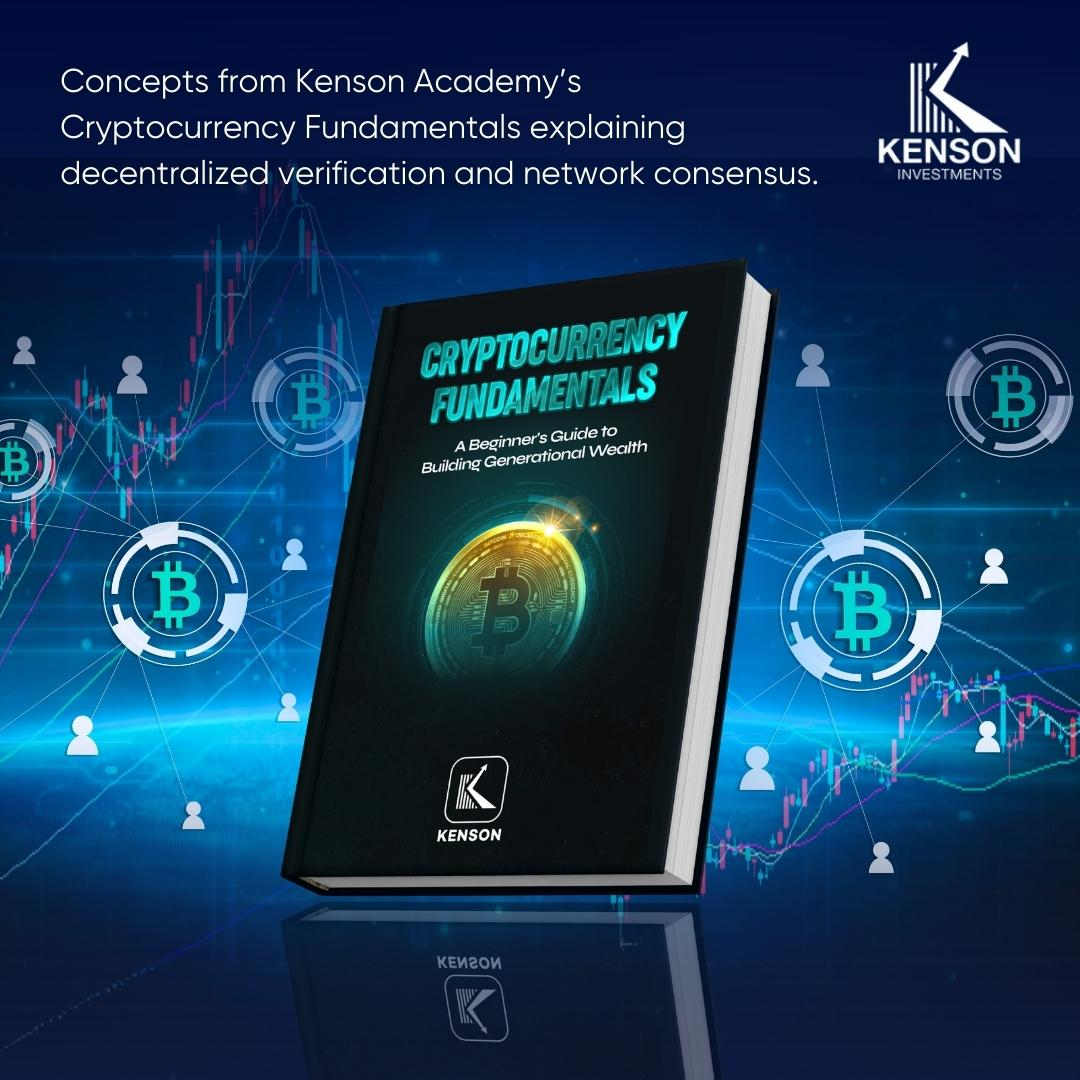
In Kenson Academy’s book Cryptocurrency Fundamentals, decentralized verification is framed not simply as a technological breakthrough but as a structural shift in how trust is coordinated across financial systems. The book emphasizes that verification architecture influences how markets maintain integrity when no single authority governs transaction approval.
From a capital preservation standpoint, institutions analyzing digital assets often focus on verification resilience, validator diversity, and governance transparency. These considerations help ensure that participation in digital markets aligns with risk management in crypto investments and broader institutional oversight frameworks.
Firms operating as a global digital asset consulting firm frequently assist institutions in understanding how consensus systems influence network security and financial stability. By emphasizing governance clarity and operational transparency, investors can approach digital asset markets with informed expectations rather than speculative assumptions.
Trust Without Central Control
Decentralized verification systems represent one of the most consequential developments in modern financial infrastructure. By distributing transaction validation across independent participants, blockchain networks enable financial systems that operate without centralized approval while still maintaining integrity and coordination.
For institutional investors navigating the digital asset market and investing in the digital age, understanding how consensus mechanisms function is essential to evaluating risk, governance, and long-term structural stability.
Readers interested in further research and educational insights on digital asset infrastructure and market structure can explore additional perspectives through Kenson Investments’ ongoing institutional analysis and educational resources.
Disclaimer: The information provided on this page is for educational and informational purposes only and should not be construed as financial advice. Cryptocurrency assets involve inherent risks, and past performance is not indicative of future results. Always conduct thorough research and consult with a qualified financial advisor before making investment decisions.
“The cryptocurrency and digital asset space is an emerging asset class that has not yet been regulated by the SEC and the US Federal Government. None of the information provided by Kenson LLC should be considered as financial investment advice. Please consult your Registered Financial Advisor for guidance. Kenson LLC does not offer any products regulated by the SEC, including equities, registered securities, ETFs, stocks, bonds, or equivalents.”