







Digital asset markets promise speed and efficiency, but that speed can conceal cumulative friction. Institutional participants increasingly recognize that excessive asset movement introduces costs that quietly erode portfolio performance over time. Network fees, execution slippage, custody transfers, tax implications, and opportunity costs compound across trading cycles, making crypto transaction costs a structural concern rather than a minor operational detail.

The issue is particularly relevant for long-term capital allocators. According to research from Fidelity Digital Assets, institutional participation in cryptocurrency markets grew sharply after 2023, with 74 percent of institutional investors reporting exposure or plans to allocate to digital assets. At the same time, global blockchain transaction activity has expanded dramatically. Ethereum alone processed more than 1 million transactions per day on average in 2025, while network fees fluctuated widely depending on congestion cycles.
These dynamics reveal a paradox. Markets built for instantaneous settlement can tempt participants to move assets frequently, yet every transfer introduces cost layers that accumulate across portfolios. The concept receives particular attention in Digital Assets for Retirement Planning, which emphasizes that capital durability often depends less on tactical movement and more on operational discipline. In an environment where digital asset transfer fees fluctuate alongside network demand, restraint can become an important form of risk management.
Structural Friction Inside Blockchain Infrastructure
Transaction friction in digital markets is frequently misunderstood because it occurs across multiple layers simultaneously. Network fees represent only the most visible component. Beneath them sit exchange execution costs, liquidity slippage, custody movement charges, and operational overhead linked to compliance monitoring and transaction verification.
Blockchain infrastructure has improved significantly in recent years, yet the fundamental cost structure remains dynamic. Data from Coin Metrics shows that Bitcoin transaction fees surged above $30 per transaction during periods of peak network congestion in 2024, while Ethereum gas costs periodically spiked beyond 200 gwei during heavy decentralized finance activity. For institutions moving large volumes of assets between custody platforms, these fees can scale quickly.
Liquidity fragmentation adds another dimension. Digital assets trade across hundreds of venues globally, creating price dispersion and execution complexity. Institutional desks therefore frequently rely on execution algorithms designed to minimize slippage across fragmented order books. Even with these tools, rapid repositioning across exchanges introduces hidden market impact.
These structural characteristics explain why many asset managers now treat transaction discipline as a portfolio construction variable. Firms focused on digital asset portfolio management increasingly model expected fee drag and liquidity impact alongside traditional performance metrics. Within that framework, unnecessary movement becomes a measurable risk factor rather than a tactical convenience.
Institutional Behavior Is Gradually Becoming More Disciplined
Institutional behavior across digital markets has evolved considerably since early retail-driven trading cycles. Major asset managers now emphasize operational stability rather than rapid asset rotation. BlackRock’s spot Bitcoin ETF launch in 2024 signaled a shift toward long-term institutional exposure structures designed to reduce direct custody transfers and transaction complexity.
Similarly, Fidelity Digital Assets expanded institutional custody infrastructure across Europe and Asia to support clients seeking long-term holdings rather than high-frequency repositioning. Institutional investors using these platforms increasingly focus on structural exposure rather than constant reallocation across tokens or exchanges.
Research from the Bank for International Settlements has reinforced this trend. BIS analysis shows that during periods of elevated volatility, crypto market spreads can widen by more than 20 percent while liquidity depth declines significantly, increasing the cost of rapid repositioning. Institutions responding to these conditions have begun prioritizing operational efficiency over tactical trading frequency.
This behavior also reflects broader portfolio management philosophy. Allocators engaged in investment analysis and portfolio management for multi-asset portfolios increasingly treat digital assets as strategic exposures rather than speculative instruments. That shift reduces unnecessary movement while aligning digital asset participation with established institutional capital frameworks.
Regulatory and Infrastructure Developments Are Changing Cost Dynamics
Regulatory developments across global markets are also influencing how frequently assets move. The European Union’s Markets in Crypto-Assets regulation, entering full operational scope by 2026, requires enhanced reporting, custody transparency, and transaction monitoring for regulated participants. These compliance layers add administrative friction to frequent asset transfers, particularly for institutions operating across jurisdictions.
Meanwhile, infrastructure development continues reshaping transaction economics. Layer 2 networks such as Arbitrum and Optimism have significantly reduced transaction costs for Ethereum-based transfers, lowering average settlement fees by more than 90 percent compared to mainnet costs during peak periods. However, these scaling solutions introduce their own operational considerations, including bridge security and settlement latency between layers.
Central banks and regulators are also examining the future of programmable settlement systems. According to international research, more than 135 countries are exploring or piloting central bank digital currencies representing roughly 98 percent of global GDP. These initiatives aim to modernize settlement infrastructure, potentially reducing friction in cross-border transfers and institutional clearing systems.
Despite these advances, the core lesson remains consistent. Infrastructure improvements reduce friction but do not eliminate it. Institutions that treat lower fees as justification for excessive asset movement may still encounter cumulative cost leakage across portfolios.
Operational Realities for Asset Managers
For professional asset managers, transaction discipline increasingly intersects with governance frameworks. Custody transfers require authorization protocols, compliance checks, and operational verification processes. Each movement therefore introduces internal administrative overhead in addition to network-level costs.
This reality is shaping how institutions approach security in digital asset management and long-term custody architecture. Many firms now segment portfolios across cold storage vaults, liquidity pools, and trading accounts to minimize unnecessary transfers while maintaining operational flexibility. Such segmentation allows portfolio managers to rebalance positions without triggering repeated custody movements.
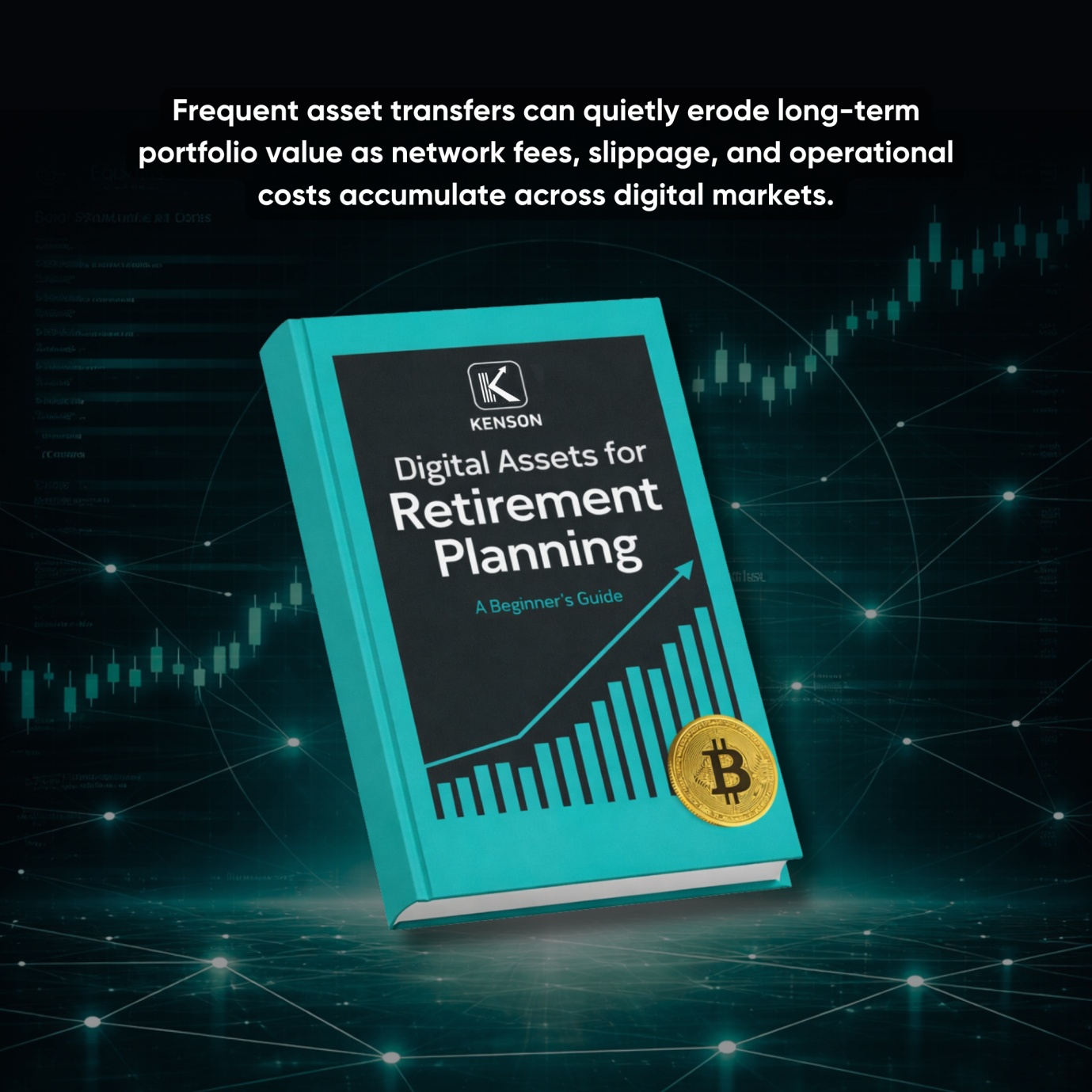
Asset managers also recognize the opportunity cost dimension of frequent transfers. Moving assets between protocols, exchanges, or wallets temporarily removes capital from productive deployment. During volatile markets, those gaps can expose portfolios to missed opportunities or unintended exposure shifts.
As a result, institutions increasingly consult leading digital asset consulting specialists to design operational frameworks that limit unnecessary movement. These frameworks often incorporate best practices in digital asset consulting related to custody architecture, execution planning, and transaction governance.
In this environment, disciplined operational design becomes a competitive advantage. Firms capable of integrating governance structures with technology infrastructure often experience lower cumulative cost leakage across long investment horizons.
What This Means in Kenson’s Framework
The discussion of transaction discipline sits at the center of the framework outlined in Digital Assets for Retirement Planning. The book emphasizes that long-term participation in digital markets depends on capital preservation as much as capital appreciation. Frequent repositioning may appear active and responsive, but it can also generate cumulative friction that undermines long-term portfolio stability.
Kenson’s research perspective therefore prioritizes operational clarity. Institutions evaluating digital markets increasingly consult digital asset strategy consulting firm partners to assess transaction structures, custody frameworks, and governance processes before expanding allocations. Within that context, consulting on digital asset management often focuses on minimizing structural inefficiencies rather than maximizing trading frequency.
This approach aligns with broader trends across institutional finance. Investors focused on long-term investment in digital assets increasingly treat operational discipline as a core pillar of risk management in crypto investments. Rather than emphasizing rapid repositioning between altcoins vs. major cryptocurrencies, institutions are developing frameworks designed to support stable exposure and capital durability.
The result is a more mature institutional mindset. Digital markets remain dynamic and technologically complex, but participation is gradually shifting toward operationally resilient structures supported by transparent investment solutions and governance-aware infrastructure.
Recognizing the True Cost of Movement
Digital asset markets reward speed and innovation, yet sustainable participation often depends on restraint. Network fees, execution slippage, tax exposure, and operational overhead collectively transform frequent asset movement into a measurable cost center. For institutional participants managing diversified portfolios, understanding these dynamics is critical for preserving capital over extended horizons.
Kenson Academy continues to examine the operational mechanics shaping digital asset markets, focusing on how governance frameworks, infrastructure design, and disciplined participation influence long-term financial resilience.
Those seeking deeper research into digital asset market structure and operational frameworks can explore additional educational insights developed by the Kenson research team by reaching out.
Disclaimer: The information provided on this page is for educational and informational purposes only and should not be construed as financial advice. Crypto currency assets involve inherent risks, and past performance is not indicative of future results. Always conduct thorough research and consult with a qualified financial advisor before making investment decisions.
“The crypto currency and digital asset space is an emerging asset class that has not yet been regulated by the SEC and US Federal Government. None of the information provided by Kenson LLC should be considered as financial investment advice. Please consult your Registered Financial Advisor for guidance. Kenson LLC does not offer any products regulated by the SEC, including equities, registered securities, ETFs, stocks, bonds, or equivalents”